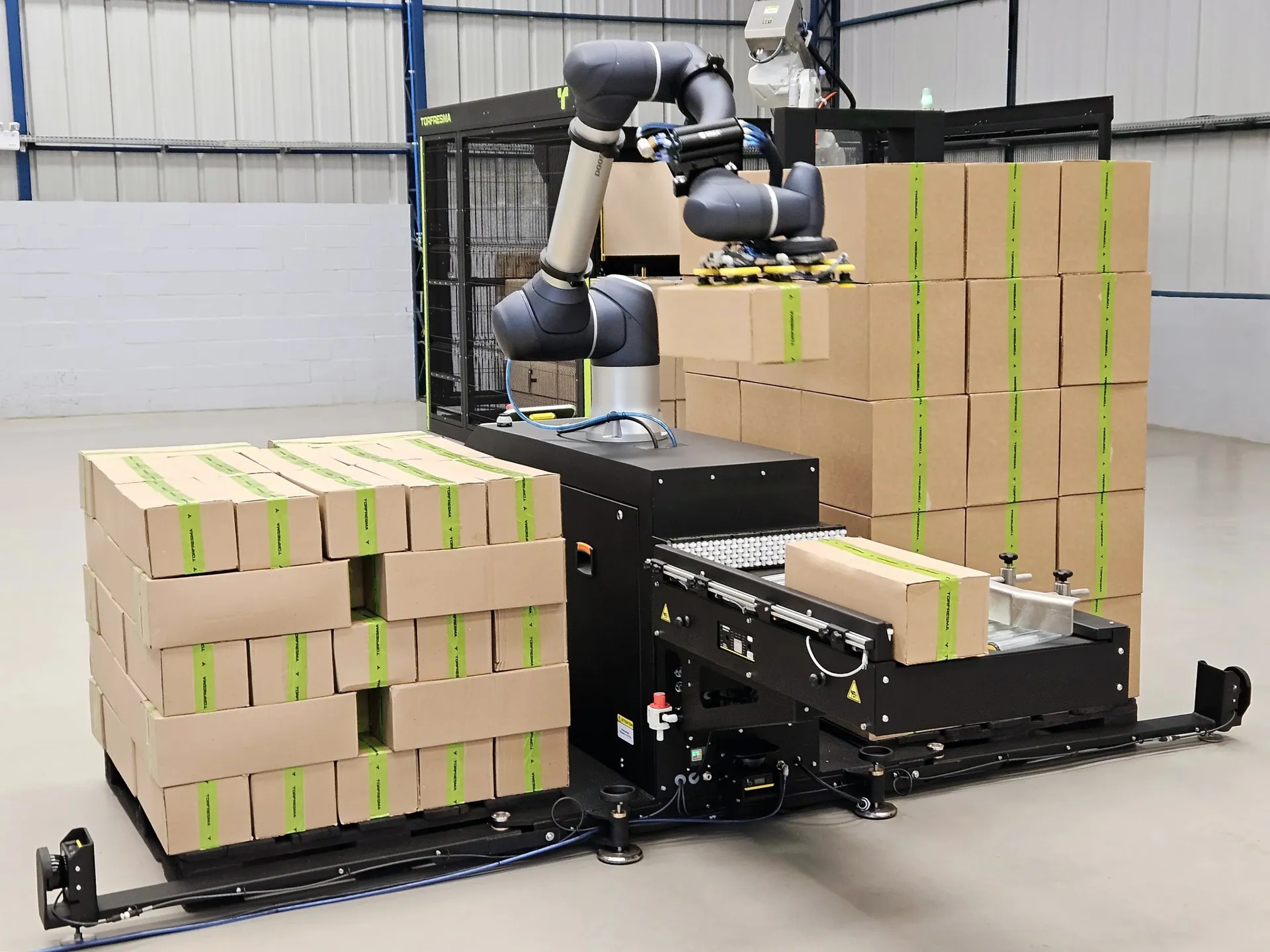
Labor
TRFCobot reduces reliance on repetitive manual palletizing, allowing operators to be reassigned to higher-value tasks while helping lower overall operating costs.
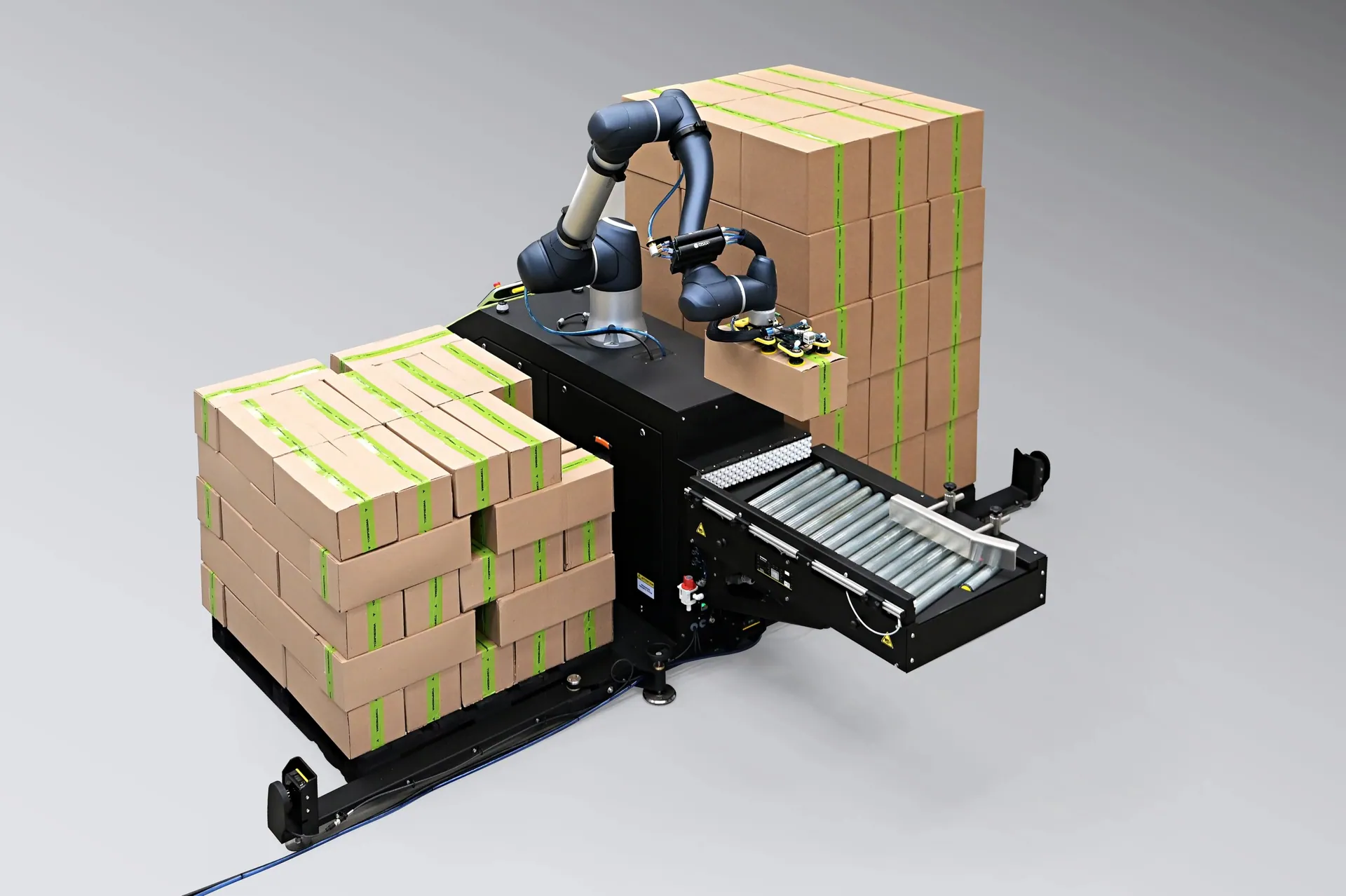
Robotic Palletizing / TRFCobot
Flexible collaborative automation with a compact footprint and fast deployment.
A cobot palletizer from TRF Industrial Automation, TRFCobot puts a collaborative robot in a standardized cell for lower-speed, high-mix lines with short runs, frequent SKU changes and limited floor space. It handles up to 10 cycles per minute and cases up to about 26 lb.
Palletizing made simple
Intuitive operation with easy recipe programming for fast product and pallet pattern changes.
Small footprint
Fits end-of-line areas where a traditional robotic cell is hard to install.
Automation that fits your line
Flexible recipes and pallet patterns that adapt quickly to every SKU and product change.
Eliminate manual palletizing
Replace repetitive manual palletizing with simple, reliable automation.
Reference list price: US$120,000 for the TRFCobot, EX Works Lenexa, Kansas. Installation, line integration and optional features are quoted according to your application.
TRFCobot is a palletizing robot designed to make robotic palletizing easier to justify, especially for production lines still relying on manual palletizing, frequent SKU changes and limited floor space. Use the reference price as a starting point for your capital planning.
Payback calculator
Discover the potential cost savings of a TRFCobot over a 20-year system life. Enter your line data to see the preview; your work email unlocks the full breakdown.
Results are estimates based on the data you enter and typical reference values. Actual payback depends on your application, configuration and project scope, confirmed by a TRF Sales Engineer.
If operators are still palletizing by hand, automation can reduce repetitive labor, improve ergonomics and create a more predictable end-of-line process. TRFCobot is specifically positioned as a lower-entry-cost path to robotic palletizing with flexibility for multiple recipes, pallet patterns and SKU changes.
Use the cobot palletizer ROI calculator to estimate your potential payback based on your location, number of shifts and current palletizing labor.
20-year labor savings
Break-even point
Your hourly labor rate
Robot hourly "labor" rate
This is an initial planning estimate, not a quote and not a guarantee of savings.
It does not include financing, taxes, layout changes or the specific integration of your line. Your complete calculation, with every item for your plant, is done with a TRF Sales Engineer.
Connect With a Sales Engineer| Year | Manual labor | System purchase | Mainte- nance | Electri- city | Robot total cost | Net savings | Cumulative savings |
|---|
This calculator compares your current manual labor costs against the total cost of owning and operating a robotic system over its 20-year lifespan, considering the system purchase price, maintenance (5% of the system price per year) and electricity. The break-even point divides the first-year system cost (purchase, one year of maintenance and one year of electricity) by the annual manual labor cost. Labor data from the U.S. Bureau of Labor Statistics; electric data from the U.S. Energy Information Administration (2024 to 2025). Figures are undiscounted and exclude inflation, financing and taxes.
| Item | TRFCobot |
|---|---|
| Robot | ABB PoWa or Doosan H2017 |
| Typical speed | Up to 10 cycles per minute |
| Case weight | Up to 26 lb |
| Pallet height | Up to 75 in |
| End-of-arm tool | Vacuum or clamp subject to end-of-arm tool and reach validation |
| Typical line | Lower speed, high mix, short runs, frequent SKU and pallet pattern changes |
| Floor space | 9L x 12W ft |
| Price | US$ 120,000 (Reference price for the TRFCobot, EX Works Lenexa, Kansas. Final pricing is confirmed based on your application, configuration and project scope.) |
Typical ranges. TRF engineering confirms final capacity for each application (product, end-of-arm tool, pallet pattern, reach and process).
TRFCobot layout options by infeed position
 Front infeed
 Double front infeed
 Left side infeed
 Right side infeed
 Double side infeed
Manufacturers choose collaborative palletizing to take repetitive manual lifting off the end of the line at a lower entry cost than a full industrial cell. These are the six reasons plants buy TRFCobot.
TRFCobot reduces reliance on repetitive manual palletizing, allowing operators to be reassigned to higher-value tasks while helping lower overall operating costs.
Manual palletizing means lifting, bending and twisting, case after case, shift after shift. A palletizing cobot takes that motion off your team.
TRFCobot offers a cost-effective entry into robotic palletizing, delivering strong labor savings and the potential for a fast return on investment.
Easily manage multiple recipes, pallet patterns and SKU changes directly through an intuitive operator interface, without complex robot reprogramming, keeping production flexible even for short runs.
Standardized design and intuitive operation simplify your first automation project, making the system easy to operate, support, and maintain.
TRFCobot fits applications where a traditional robotic cell would be difficult to install: automate the repetitive work without over-automating the process.
A cobot palletizer is a compact palletizing system built around a collaborative robot, designed to automate repetitive case stacking while working safely alongside operators when the application and safety assessment allow it. Unlike traditional robotic cells, a collaborative system can often be designed without full perimeter fencing, reducing footprint and improving operator access.
This collaborative architecture can also make pallet handling more flexible. In a dual-pallet configuration, the robot can continue palletizing on one side while an operator removes a completed pallet and positions an empty pallet on the other. With properly designed safety zones and controls, pallet changes can take place without stopping the entire palletizing process, helping maintain a more continuous production flow.
Traditional industrial palletizers are typically designed for higher speeds, heavier payloads and demanding duty cycles, often requiring dedicated guarding, conveyors and pallet-handling equipment. For lower-volume or high-mix production lines, that level of automation can add unnecessary footprint, complexity and investment.
TRFCobot is designed for a different need: simple, flexible and accessible palletizing automation. Its compact collaborative architecture, intuitive recipe control and operator-friendly design make it ideal for lower-speed lines, frequent SKU changes and facilities looking to automate palletizing without over-automating the process.
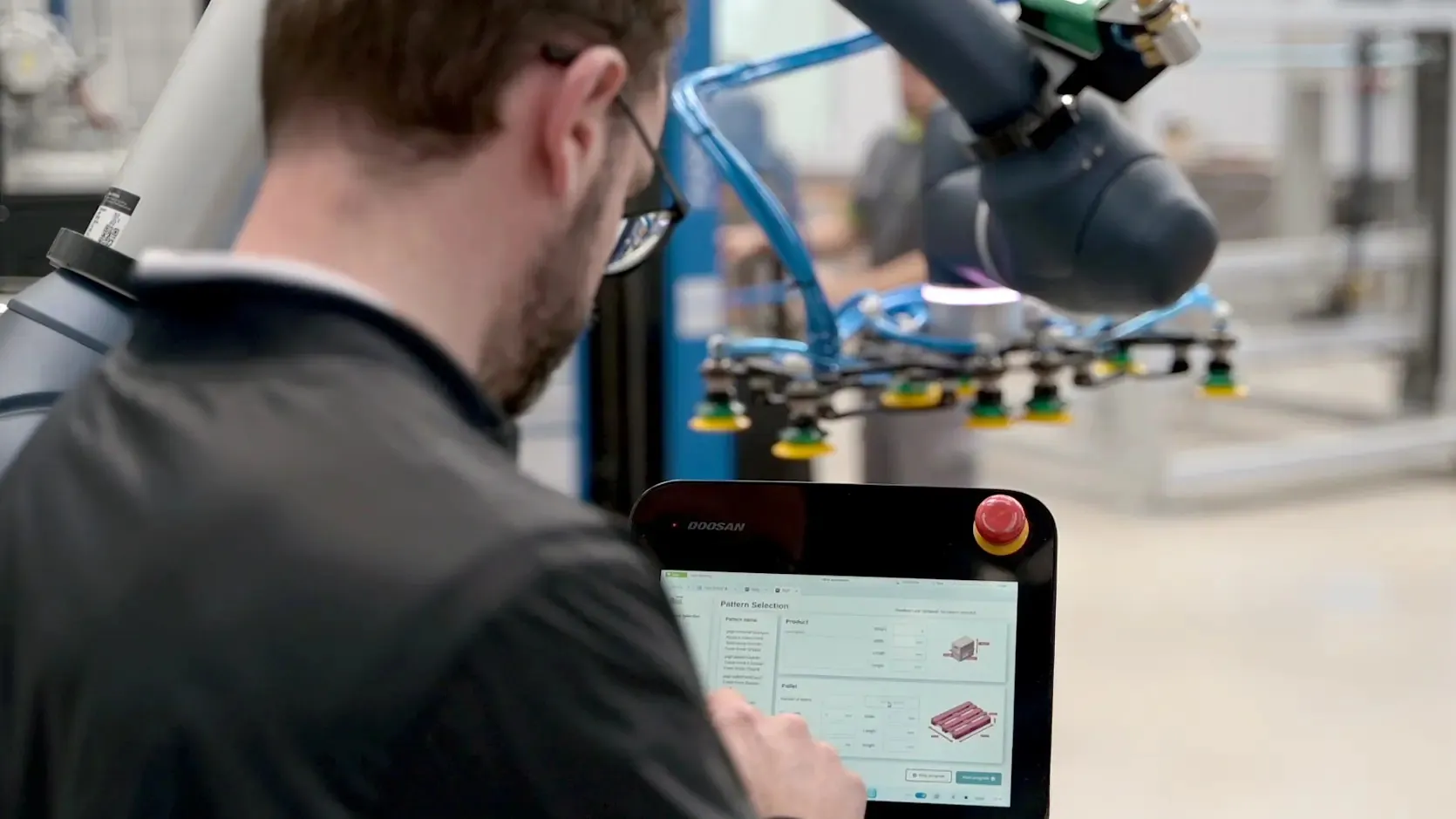
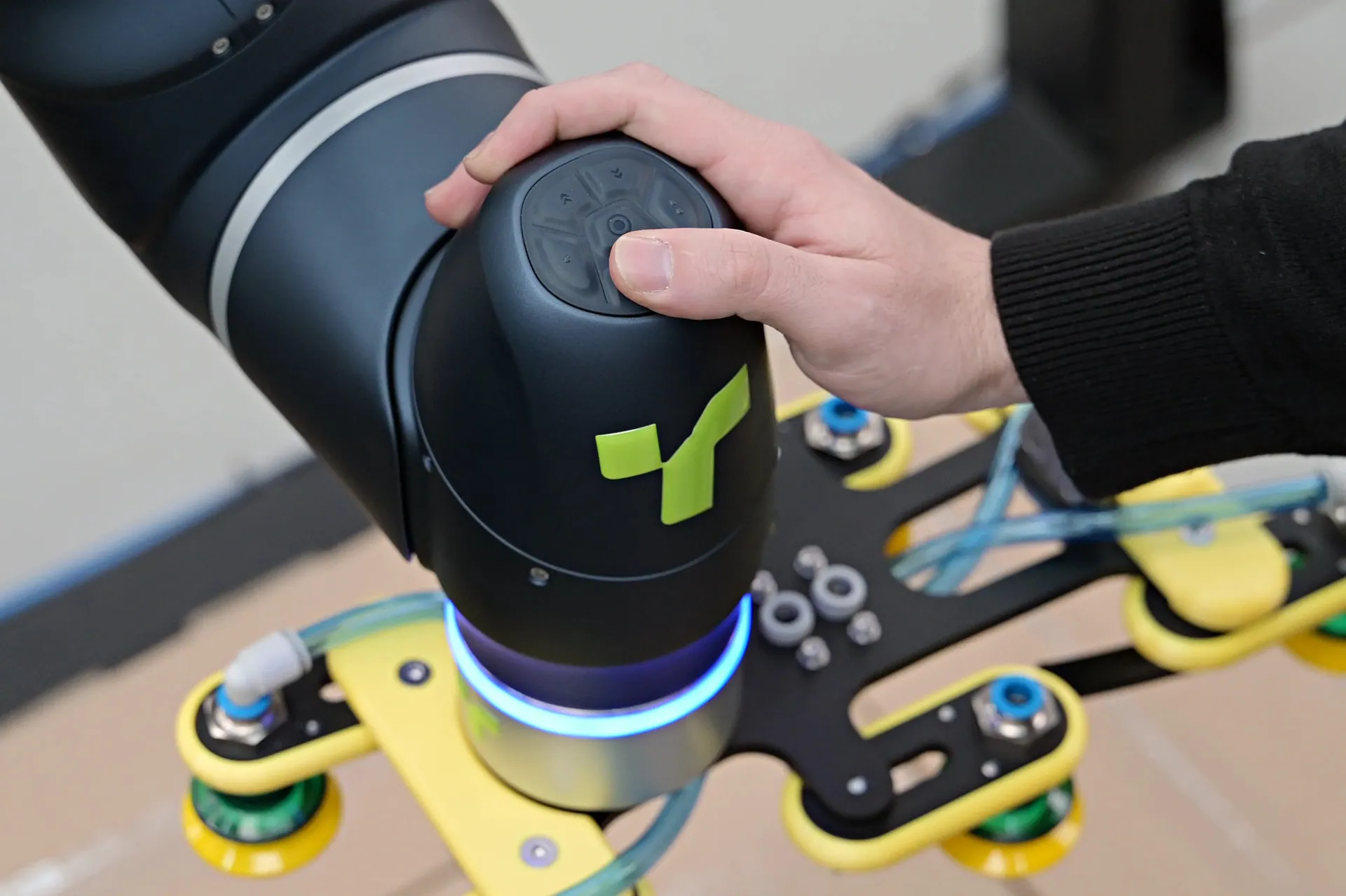
Cobot palletizing fits lines where manual palletizing still takes one or more operators and the rate is up to 10 cases per minute. Five customer profiles fit TRFCobot:
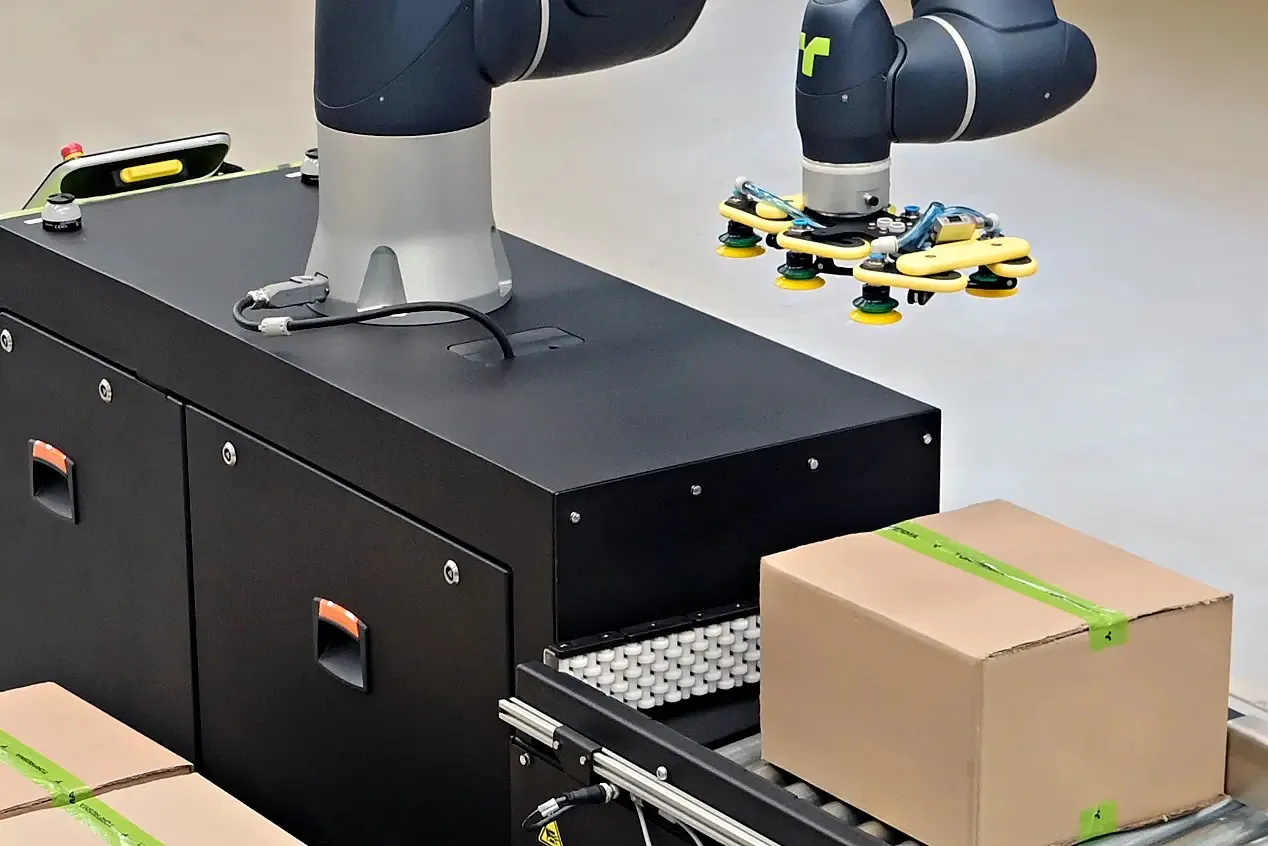
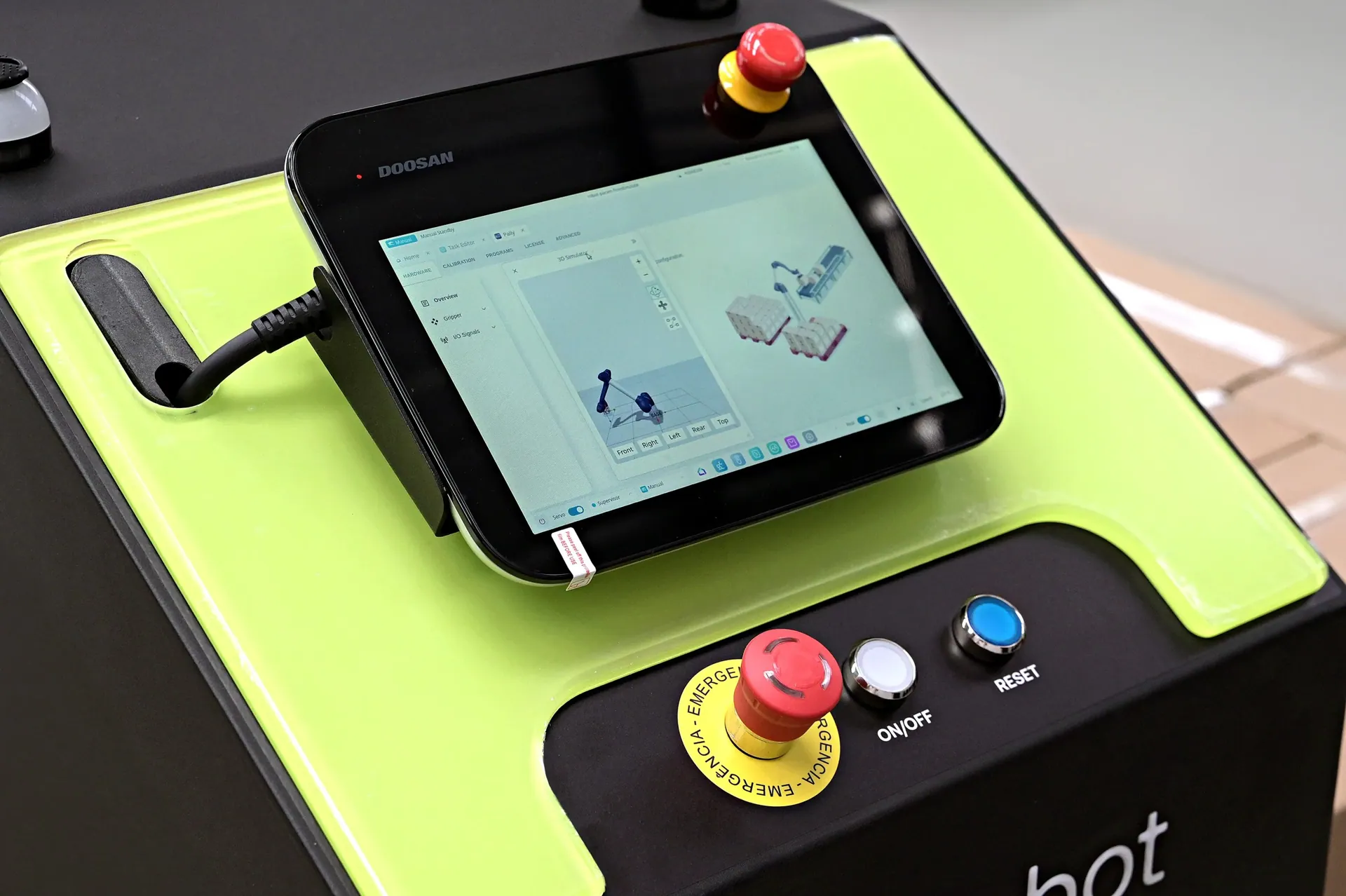
Your line is a strong candidate for TRFCobot when most of these statements are true:
Before quoting, TRF validates five factors with your line data:
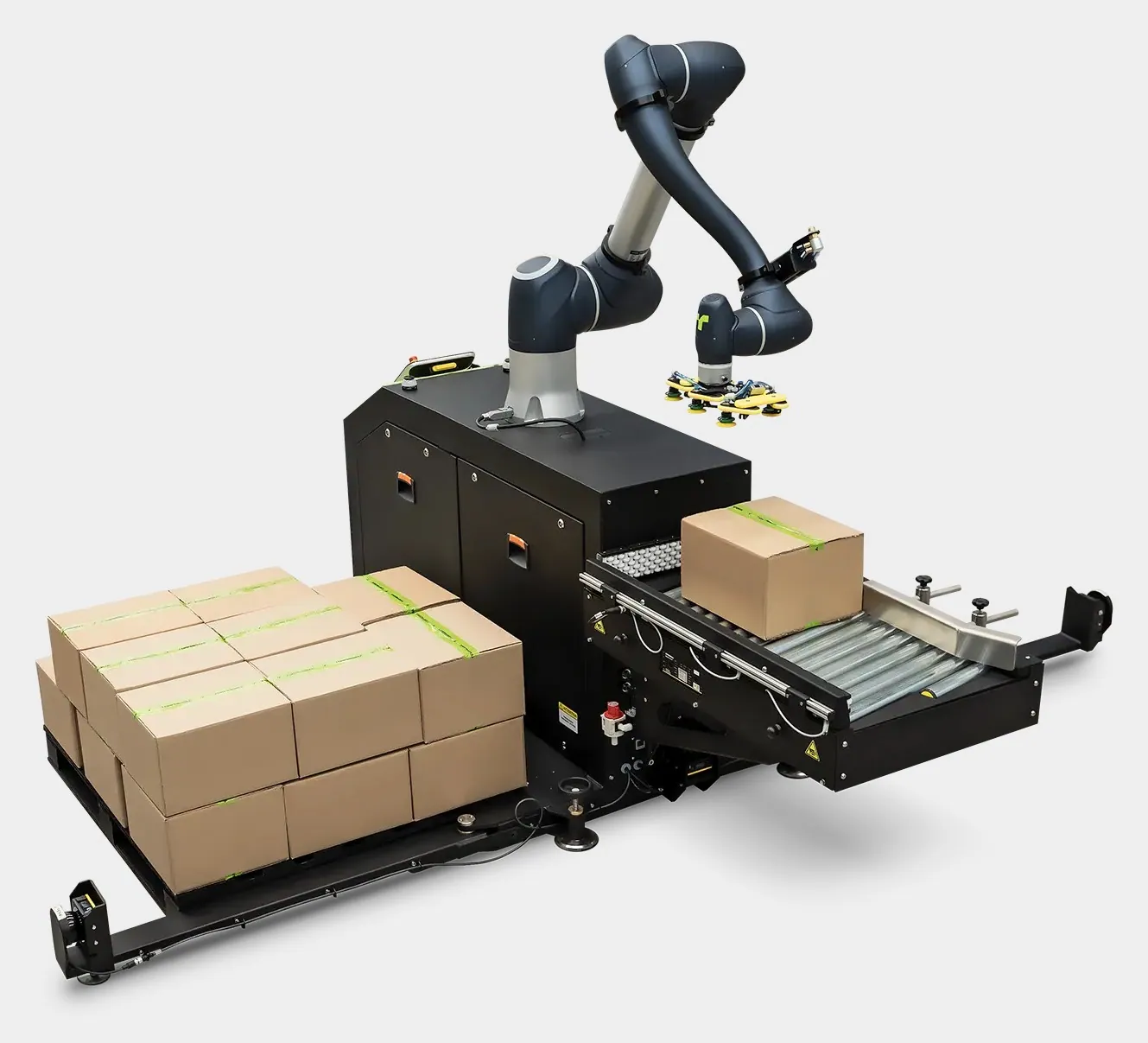
Choose by line speed, case weight and floor space. The three TRF palletizing platforms form one family, and the right model is defined by your line setup and rate.
| Platform | Typical speed | Case weight | Typical fit |
|---|---|---|---|
| TRFCobot | Up to 10 cases per minute | Up to 26 lb | Lower-speed, high-mix lines with limited floor space |
| TRFCompact | Up to 15 cases per minute | Up to about 65 lb | Medium-speed, limited floor space |
| TRFSpeed | 15 cases per minute or more | Up to about 80 lb | High volume, continuous or multi-line palletizing; TRFSubzero for areas below 32°F |
If your rate, case weight or growth plans go beyond the range of one platform, the next platform in the same family covers higher speeds and payloads. Compare all platforms on the robotic palletizing page. Each platform can also be the last station of a complete TRF end of line, with case packing and conveying supplied by the same partner.
Catalog
Tell us who you are and download the TRFCobot catalog right away, with specifications, layout options and configurations.
Thank you.
Your TRFCobot catalog is ready. A TRF Sales Engineer may follow up about your project.
Download the TRFCobot catalog (PDF)Questions
The cobot palletizer price for TRFCobot is a reference list price of US$120,000, EX Works Lenexa, Kansas, installation not included. Installation, line integration, the gripper and the conveyor interface are quoted for your application, since line speed, case weight, pallet pattern and layout all affect the scope. Use the payback calculator on this page to estimate what manual palletizing is costing you today.
A cobot, short for collaborative robot, is a robot arm designed to work in shared workspaces at moderate speeds and payloads. It is usually easier to program and deploy than a traditional industrial robot. In palletizing, a cobot is the right fit for lower rates and lighter cases. TRFCobot puts a collaborative robot in a standardized cell with a small footprint and simple, recipe-based operation.
A cobot palletizer handles fewer cases per minute than an industrial robot cell. TRFCobot handles up to 10 cases per minute. Lines that run faster move up to TRFCompact, at up to 15 cases per minute, or TRFSpeed, at 15 or more. TRF confirms the final rate for your product, end-of-arm tool, pallet pattern and reach.
A cobot palletizer lifts lighter cases than an industrial cell. TRFCobot handles cases up to 26 lb, subject to end-of-arm tool and reach validation. The robot carries the case plus the tool, and the combined weight when it picks more than one case at a time. Heavier cases point to TRFCompact, up to about 65 lb, or TRFSpeed, up to about 80 lb.
Yes. TRFCobot supports multiple recipes, pallet patterns and SKU changes without the complexity of a large custom system, which is why it fits co-packers, contract manufacturers and plants with short runs. Each recipe stores the case data and the pallet pattern for one product, and the end-of-arm tool and reach are validated for every case size in your mix.
Before buying a cobot palletizer, confirm the floor area for the robot, the infeed pick point, one or more pallet positions and operator access to remove full pallets. A standard TRFCobot cell takes about 9 ft by 12 ft and builds pallets up to 75 in high. Then confirm reach: the robot must be able to place the farthest case on the top layer of your tallest pallet. Pallet height and case size change the answer, so TRF validates reach, end-of-arm tool and pallet pattern for each application.
Cobot palletizer ROI depends on the labor hours the cell replaces, shifts per day, local labor cost and the installed cost of the system. TRFCobot is the lower-entry-cost path to robotic palletizing, particularly in one- to three-shift operations. The calculator on this page uses your state, your shifts and the people who palletize by hand today.
If your line runs up to 10 cases per minute, changes SKUs often and has little room at the end, TRFCobot is the cobot palletizer TRF built for that reality. Start with your production information: products, case weights, rates, pallet patterns and a drawing of the area. A TRF Sales Engineer validates the fit and confirms the scope.
Want to see TRF installations first? Browse the TRF case studies.