
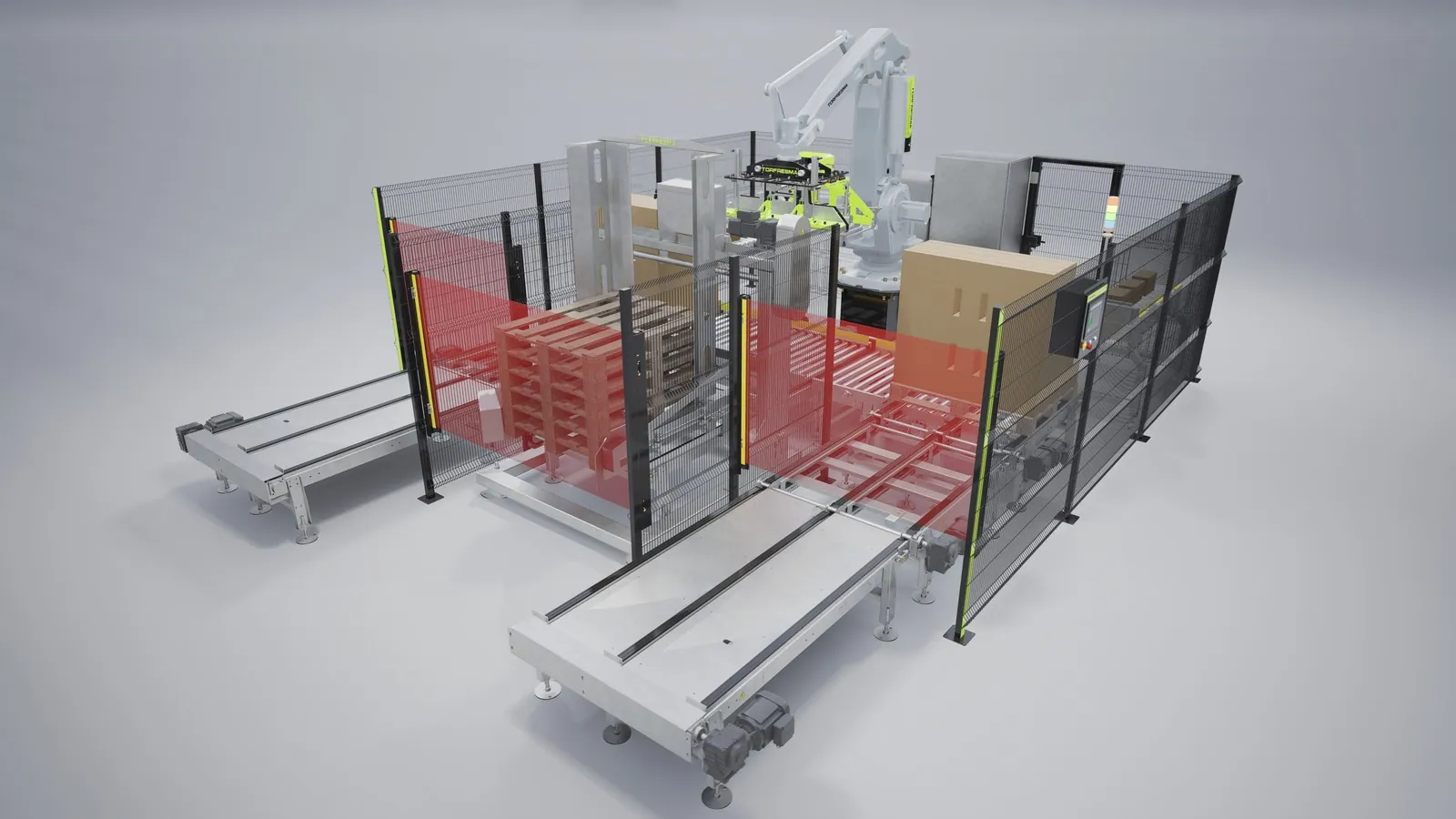
Robotic Palletizing / Tray Palletizer
Tray palletizer sized to your line and tray weight.
Take repetitive lifting off your operators, with a palletizer sized to your line rate and tray weight.
A tray palletizer is a robotic system that stacks loaded trays, such as bakery, dairy or meat trays, onto pallets in a stable pattern, using tooling selected for the tray format and weight. TRF Industrial Automation builds tray palletizers on TRFCobot, TRFCompact and TRFSpeed, or as a custom palletizer, and the right model is defined by your line setup and speed.
Custom engineering
Solutions engineered for your production requirements.
Turnkey integration
From system design through installation and startup.
High reliability
Built for continuous operation.
U.S. support
Technical support for customers across the United States.
Lifecycle support
From startup to long-term performance.
Tray palletizer key facts
| Item | What to know |
|---|---|
| What it does | Stacks loaded trays, open or film-wrapped, onto pallets in a stable, repeatable pattern |
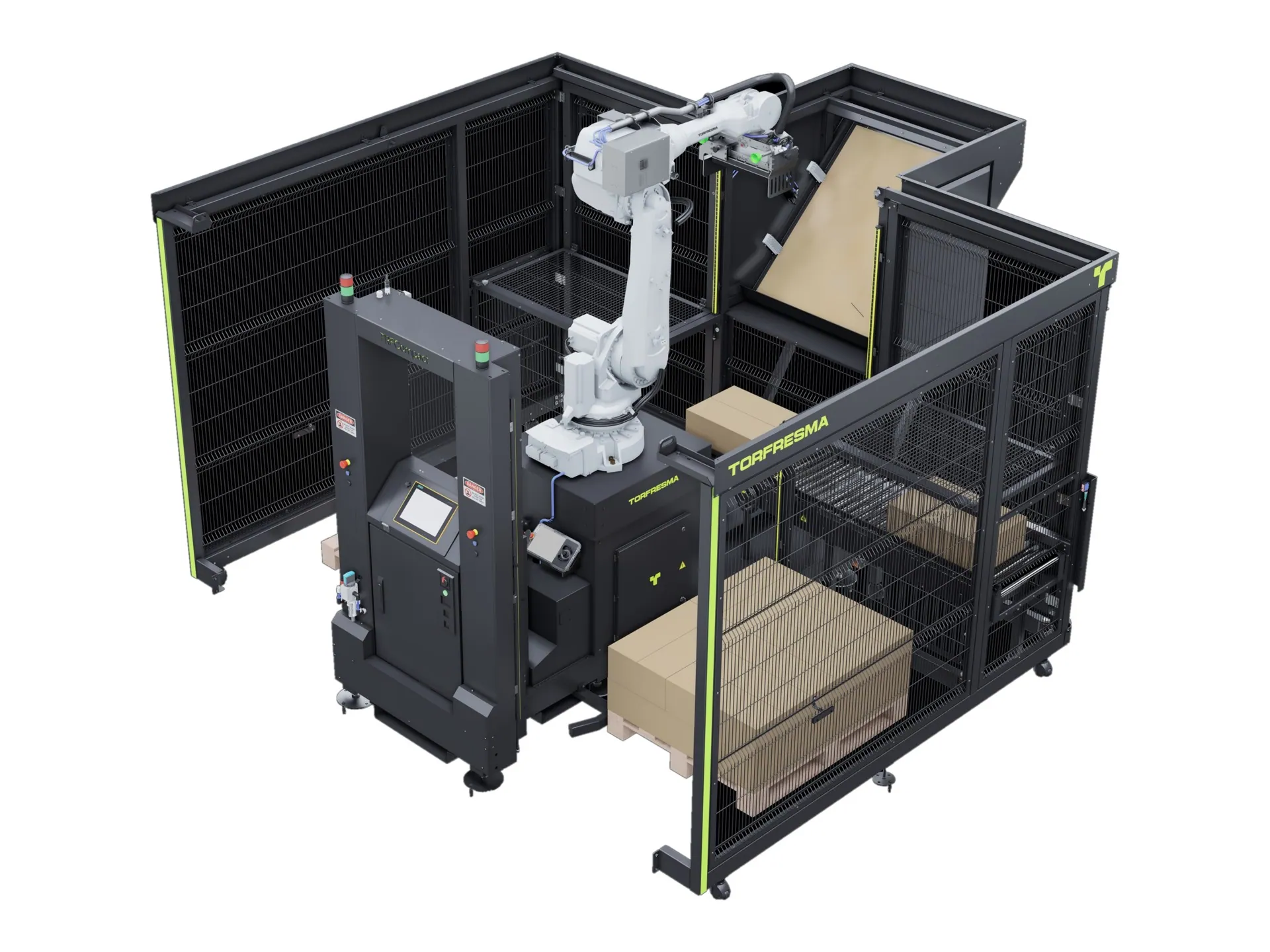
| TRF models | TRFCobot, TRFCompact and TRFSpeed, plus a custom palletizer when the application falls outside them |
| What decides the model | Line setup and speed first, then loaded tray weight, tooling, the room and the floor space |
| Tooling | Selected for the tray format, since an open tray offers no packaging surface on top |
| Crates | Reusable crates are covered in the crate palletizing section of this page |
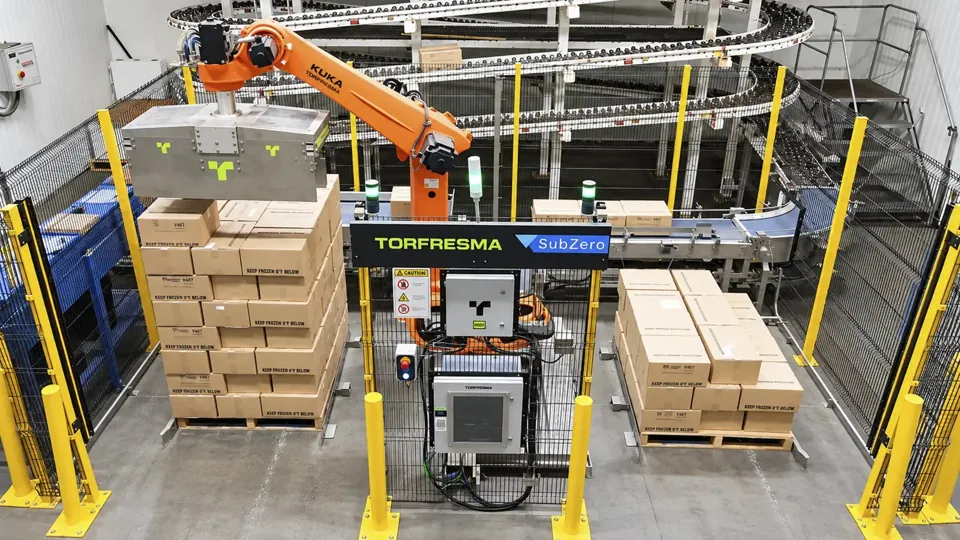
| Palletizing below 32°F | TRFSubzero, the TRF palletizer for below-freezing areas (below 32°F) |
What is a tray palletizer?
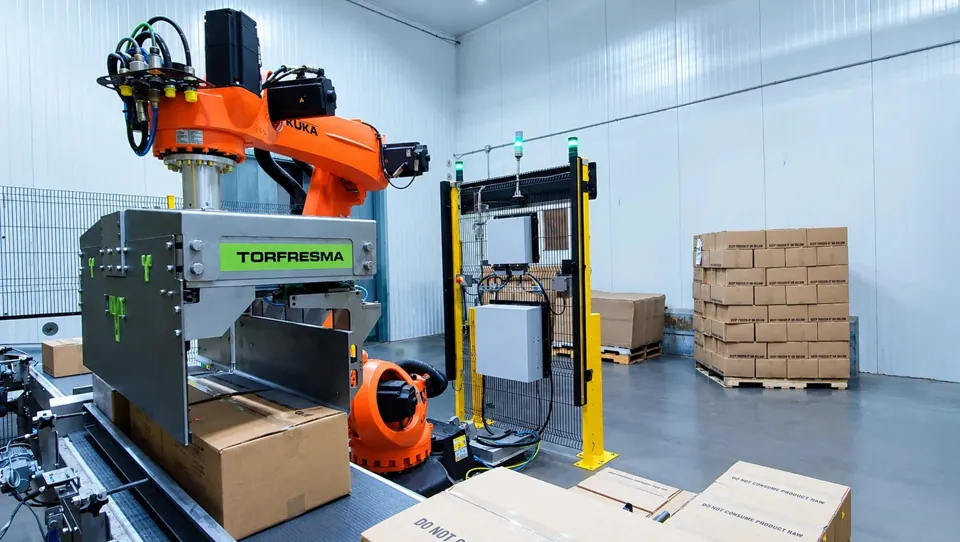
A tray palletizer is the robotic cell that takes loaded trays from a conveyor and builds them into pallet loads. The trays may hold cups, tubs or cans, carry film-wrapped packaged product, or be plastic trays of bakery, dairy or meat items. The robot places each tray where the recipe defines, layer after layer, and the finished load moves to wrapping or into cold storage.
Tray stacking by hand is hard work: wide, shallow units, sometimes wet, often cold, lifted over and over on every shift. That is why a tray palletizing project usually starts as an ergonomics and staffing conversation, and only then becomes a throughput conversation. Trays are palletized in bakery and snacks, dairy and cheese, protein processing and frozen food and ice cream plants.
What Makes Trays Hard to Palletize?
- No top surface. An open tray exposes product, not packaging, so the robot has to work from the sides or from underneath.
- The product carries the load. In a stack of open trays, the weight above rests on the tray walls, the corners or the product itself, and poor alignment crushes what is inside.
- Shallow units, many layers. Small placement errors accumulate up the stack.
- Slippery, cold and wet. Film-wrapped trays slide on each other, and dairy, protein and frozen lines add condensation and cleaning routines.
How does a robot grip an open tray without touching the product?
By working from the base or the sides. Tooling that slides under the tray carries it from below, while clamp or rim tooling holds the tray walls or lip. A film-wrapped tray with a continuous film surface can sometimes be handled from above. The tooling is selected for your tray format and validated with your trays, loaded as they run and at the temperature they reach the palletizer.
Tooling that supports or clamps trays can weigh more than a simple pick head, and it counts against the robot payload together with the loaded tray. A tray that flexes when full also behaves differently from the empty sample that usually arrives first, which is why validation uses production trays.
Keeping the Tray Stack Stable
- Align the load path. Trays stack most securely when walls and corners line up, so the weight travels down the structure rather than through the product.
- Use tier sheets where the stack needs a floor. A sheet over a layer of open trays spreads load and gives the next layer a flat surface.
- Fight the slide. Layer sheets, pattern choice and wrap tension keep film-wrapped trays square.
- Respect the pallet height. Cooler and freezer racking, truck height and how trays behave under load set the number of layers.
What is a crate palletizer?
A crate palletizer stacks rigid reusable crates, the open containers that bakery, dairy and protein operations use to move product between plants, distribution centers and stores. Crates and trays often appear in the same plant, and even on the same line, which is why crate palletizing is covered on this page.
Crates change the problem in three ways:
- They are designed to stack. Feet, rims or interlocking features seat one crate into the one below, so column stacking is the natural pattern and placement accuracy matters more than pattern complexity.
- They are rigid. A crate carries the load of the crates above it, which protects the product inside.
- They give the robot something to hold. Rims, handles and strong sidewalls suit tooling that clamps the walls or hooks the rim.
Crate applications are screened the same way as trays, by rate, loaded crate weight, number of formats, floor space and the room the cell will work in, and validated per application. Where a crate application needs handling the standard platforms do not cover, it is evaluated as a custom palletizing project.
How do you choose a tray palletizer?
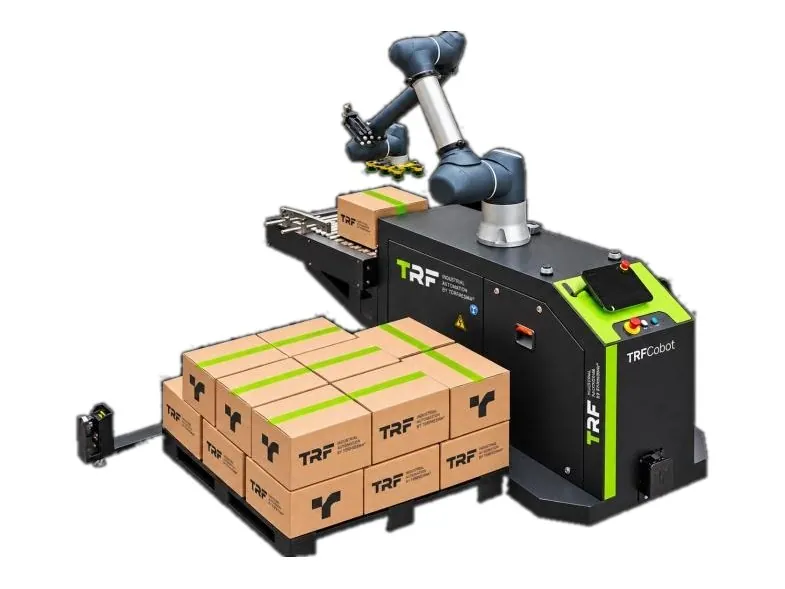
Choose by line setup and speed: trays per minute at peak, including bursts after an oven, a cooler or a packing machine, how many lines feed the palletizer and the room it will work in. The loaded weight of the heaviest format, plus the tooling, then confirms the choice.
| Platform | Typical speed | Case weight | Best fit |
|---|---|---|---|
| TRFCobot | Up to 10 cases per minute | Up to 26 lb | Lower-speed, high-mix lines with limited floor space and manual palletizing today |
| TRFCompact | Up to 15 cases per minute | Up to about 65 lb | Industrial duty cycle in a compact, standardized cell for brownfield plants and secondary lines |
| TRFSpeed | 15 or more cases per minute | Up to about 80 lb | High-volume or continuous production, several lines into one palletizing area, automatic pallet handling |
| Custom palletizer | Defined by the project | Defined by the project | Tray formats, stacking rules or layouts that the three platforms do not cover |
Published ranges are stated in cases for commercial screening. For trays and crates, the rate, the loaded weight and the platform are validated per application (product, end-of-arm tool, pallet pattern, reach and process).
When two platforms could both work, TRF recommends the one that matches your throughput, production intensity and growth plans, not simply the lowest initial investment. When packing, conveying and palletizing are all in scope, end-of-line integration delivers them as one project with one partner accountable for the agreed project scope. Compare every model on the robotic palletizing page.
Questions
Frequently asked questions
Can a Tray Palletizer Work in a Freezer or a Chilled Room?
Yes, a tray palletizer can work in a freezer: for palletizing areas below 32°F, TRFSubzero is the TRF palletizer built for frozen food, ice cream and other below-freezing areas. For a chilled room above freezing, send TRF the room temperature so the application can be evaluated. In every case, rate, payload and tooling are validated per application with your trays.
Can One Tray Palletizer Handle Several Tray Formats?
Yes, one tray palletizer can handle several tray formats within the validated application. Each format and pallet pattern is stored as a recipe, so the operator selects the pattern at changeover. The practical limits are the tooling's ability to hold every format securely, the robot's reach at the tallest stack and the number of pallet positions the layout allows, all confirmed during project engineering.
What Is the Difference Between a Tray Palletizer and a Tray Packer?
The difference between a tray palletizer and a tray packer is where they work: a tray packer loads packaged trays into shipping cases, while a tray palletizer stacks trays, or the finished cases, onto pallets. They often work together on one line, with a case packer packing the trays, a case palletizer building the pallet of cases and conveying connecting them.
What Payload Does a Palletizing Robot Need for Loaded Trays?
A palletizing robot for loaded trays needs a payload that covers the loaded tray plus the tooling, and the combined weight in a multi-tray pick. Published case weights are up to 26 lb for TRFCobot, 65 lb for TRFCompact and 80 lb for TRFSpeed. Tooling that supports trays from below can weigh more than a simple pick head, so TRF validates the payload with your heaviest loaded tray.
Can a Tray Palletizer Be Used in a Protein Plant?
Yes, a tray palletizer can be used in a protein plant for packaged trays and crates. Packaged trays move between machines on TRFIntraflow, and palletizing below 32°F points to TRFSubzero. Sanitary conveying for exposed product upstream is evaluated per application with TRFCleanflow. Each application is validated with the plant's tray formats, cleaning routines and room conditions.
How Much Does a Tray Palletizer Cost?
A tray palletizer costs according to its platform, rate, loaded tray weight, tooling, pallet positions, pallet handling and the conveying around the cell. As a reference, list prices are US$ 120,000 for the TRFCobot, US$ 180,000 for the TRFCompact Dual and US$ 350,000 for the TRFSpeed 100, EX Works Lenexa, Kansas, installation not included. The robotic palletizer cost page explains each factor.
What Information Should I Prepare to Size a Tray Palletizer?
To size a tray palletizer, prepare your tray and crate formats with dimensions, the loaded weight of the heaviest format, trays per minute at peak, shifts per day, the room conditions (chilled, frozen or washdown), stacking rules and a drawing of the floor space. A TRF Sales Engineer uses this data to screen TRFCobot, TRFCompact, TRFSpeed or a custom palletizer, and the payback calculator gives a first estimate.
Start your tray palletizer evaluation
A tray palletizer is defined by the tray in your plant: its format, its loaded weight, the room it is stacked in and the rate your line runs. Send TRF your tray and crate formats with rates and stacking rules, and a Sales Engineer will validate the tooling, the patterns and the reach with your trays.
Want to see TRF installations first? Browse the TRF case studies.
Next step
Keep your production running.
Tell us about your products, rates and floor space. A TRF Sales Engineer answers with the platform, the layout and the next step for your line.