
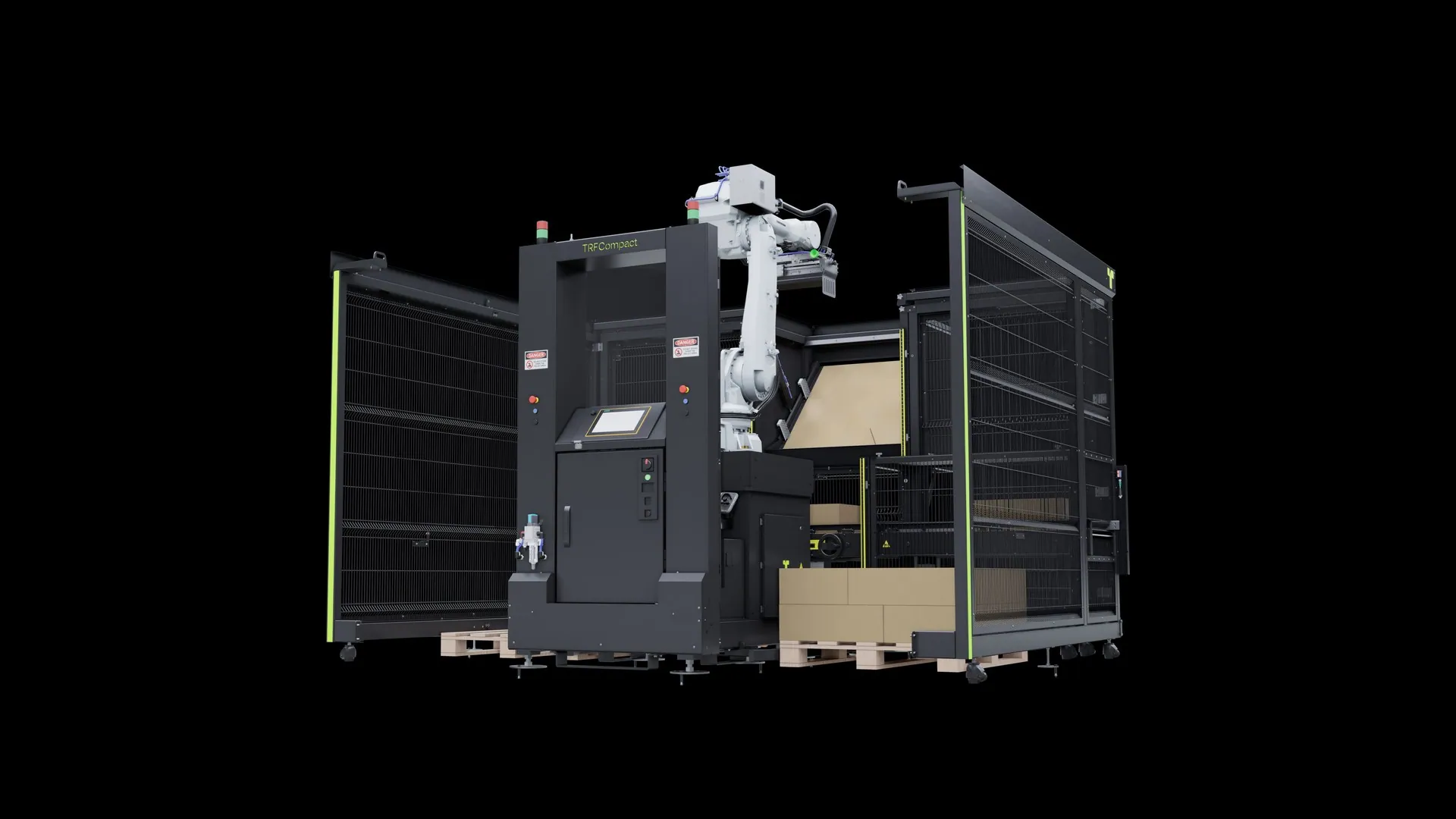
Robotic Palletizing / Bag Palletizer
Bag palletizer sized to your bag weight and line rate.
Take heavy lifting off your crew, from cobot cells to high-speed systems.
A bag palletizer is a robotic system that picks filled bags from a conveyor and stacks them onto pallets in a set pattern, using end-of-arm tooling selected for the bag type, weight and rate. TRF Industrial Automation builds bag palletizing systems on TRFCobot, TRFCompact and TRFSpeed, or as a custom palletizer, and the right model is defined by your line setup and speed.
Custom engineering
Solutions engineered for your production requirements.
Turnkey integration
From system design through installation and startup.
High reliability
Built for continuous operation.
U.S. support
Technical support for customers across the United States.
Lifecycle support
From startup to long-term performance.
Bag palletizer key facts
| Item | What to know |
|---|---|
| What it does | Picks filled bags, sacks and film-wrapped bundles from the infeed conveyor and stacks them on a pallet in a programmed, interlocked pattern |
| TRF models | TRFCobot, TRFCompact and TRFSpeed, plus a custom palletizer when the application falls outside them |
| What decides the model | Line setup and speed first, then bag weight, number of lines, floor space and pallet handling |
| What is validated | The actual bag, the end-of-arm tool, the pallet pattern, the robot reach and your process |
| Integration scope | Conveyors, accumulation, pallet handling, slip sheets, wrapping, labeling and warehouse interfaces, defined per project |
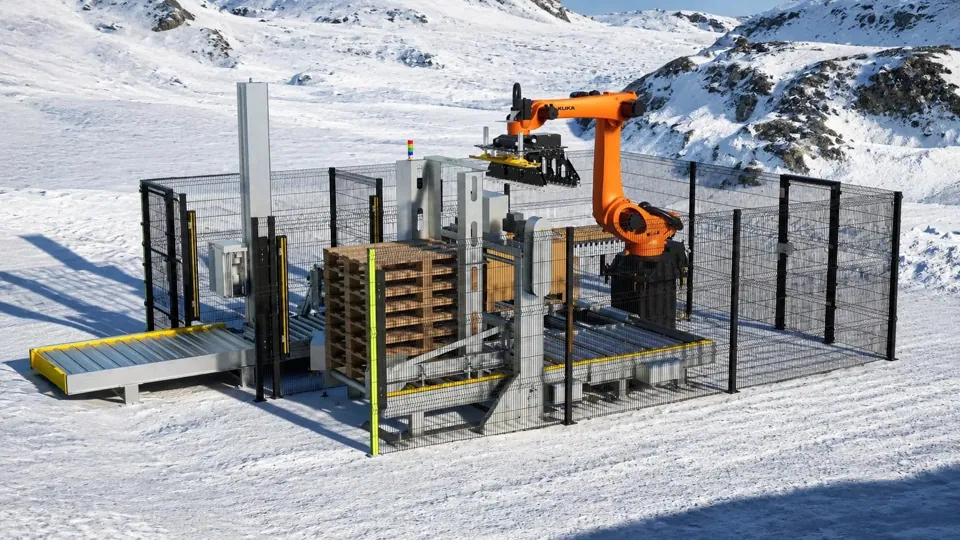
| Palletizing below 32°F | TRFSubzero, the TRF palletizer for below-freezing areas (below 32°F) |
What is a bag palletizer?
A bag palletizer takes over the lifting, turning and stacking of filled bags that operators otherwise do by hand after the bagging machine. The bag palletizing robot picks each bag from the infeed conveyor, places it where the pallet pattern defines and repeats the cycle layer by layer until the pallet reaches its target height. The finished pallet then moves on to wrapping, labeling and shipping.
Because the pattern lives in software, the cell follows product changes without a mechanical rebuild. Operators move from lifting bags to supervising the cell, checking quality and handling changeovers.
Bags are palletized in pet food, chemicals and food processing plants that pack grains and ingredients, and on shared lines at co-packers. In every one of them, the business case starts with the same two drivers: less dependence on repetitive manual palletizing, and less repeated lifting, bending and twisting at the end of the line.
Why Bags Are Harder to Palletize Than Cases
- No rigid shape. A bag takes its shape from how it was filled and how the product settles on the way to the palletizer.
- The contents move. When a bag is lifted, the product flows toward the low points, so the bag sags between the points where it is held.
- Uneven layers. A layer of bags forms crowns and valleys, and the next layer has to sit on that surface without sliding.
- Stability comes from interlocking. A column of cases stands on its own walls. A stack of bags relies on friction and on bags bridging the joints of the layer below.
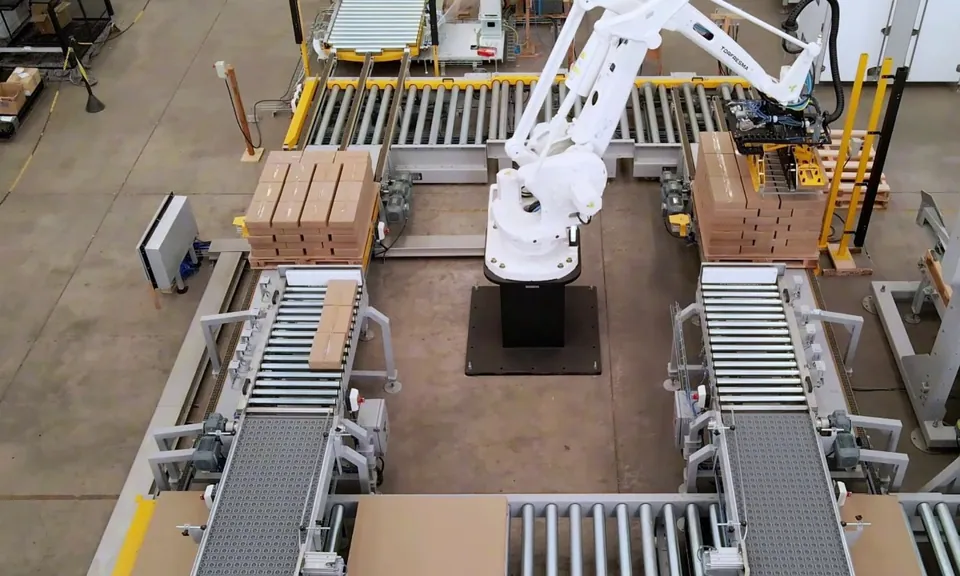
How do you keep a pallet of bags stable?
A stable pallet of bags comes from three decisions made together: an end-of-arm tool that supports the bag without deforming it, a pattern that interlocks the layers, and layer sheets where the bag surface needs friction. Get one of them wrong and the pallet still leans.
The end-of-arm tool. The tool is selected for your bag type, size, weight and surface. A soft, heavy bag generally needs support across its base so the contents do not pull it out of shape, and the tool weight counts against the robot payload. TRF validates the tool with your actual bags, filled the way your line fills them.
The pallet pattern. Like bricks in a wall, each layer is rotated or mirrored so bags bridge the joints of the layer below, which ties the load together. Column stacking, where every layer repeats the same footprint, is rarely stable for bags. The pattern also keeps bags inside the pallet edge, because overhang scuffs bags and pulls the load outward.
Sheets and the pallet. Slip sheets or tier sheets between layers add friction between slippery bag surfaces and spread the weight above, and a sheet on the pallet deck protects the first layer from gaps and broken boards. On TRFSpeed projects, slip sheet handling is part of the integration scope; on smaller cells, the approach is defined with the application.
Where the application needs it, flattening the bag upstream gives the robot a consistent height and footprint, and consistent bags build level layers. The result is a square, tight load that wraps and ships predictably.
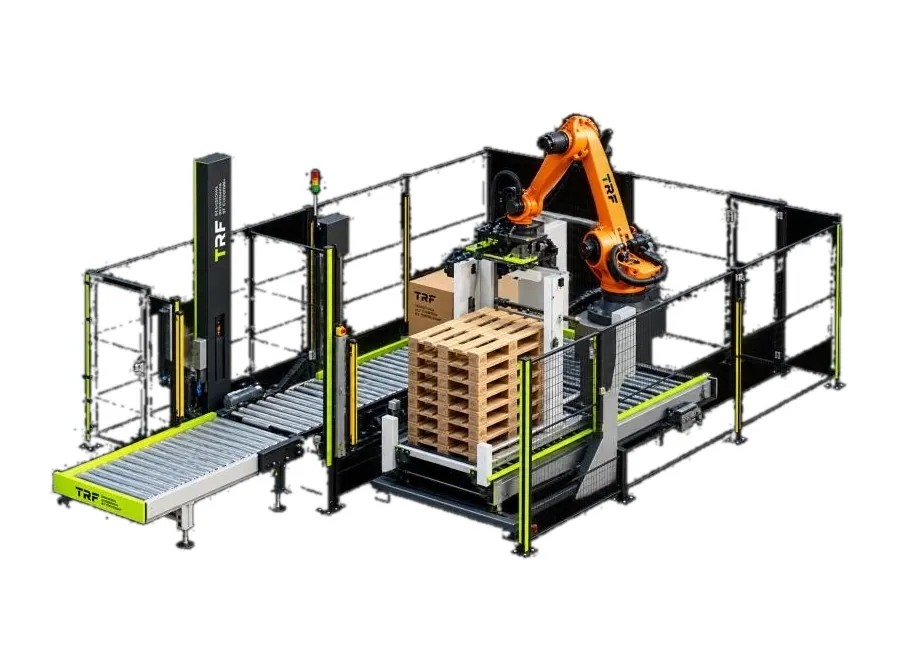
What is a sack palletizer?
A sack palletizer is a bag palletizer applied to heavier industrial sacks, such as the sacks used for grains, ingredients and chemicals. In most plants "sack" and "bag" describe the same machine, but sacks tend to bring more weight, more dust and more variation in surface and shape.
Weight is usually the first question for sacks. When the sack is heavier than the published payload of the standard platforms, or the rate or layout goes beyond them, TRF evaluates a custom palletizer project. For every sack, the end-of-arm tool, the pattern and the reach are validated with real filled sacks.
Sack construction changes how the tool grips and how the layers hold together, so the pattern and the use of slip sheets are chosen for each sack. In dusty areas, the project also defines sensor selection, cleaning access and how the tooling sheds residue in your environment.
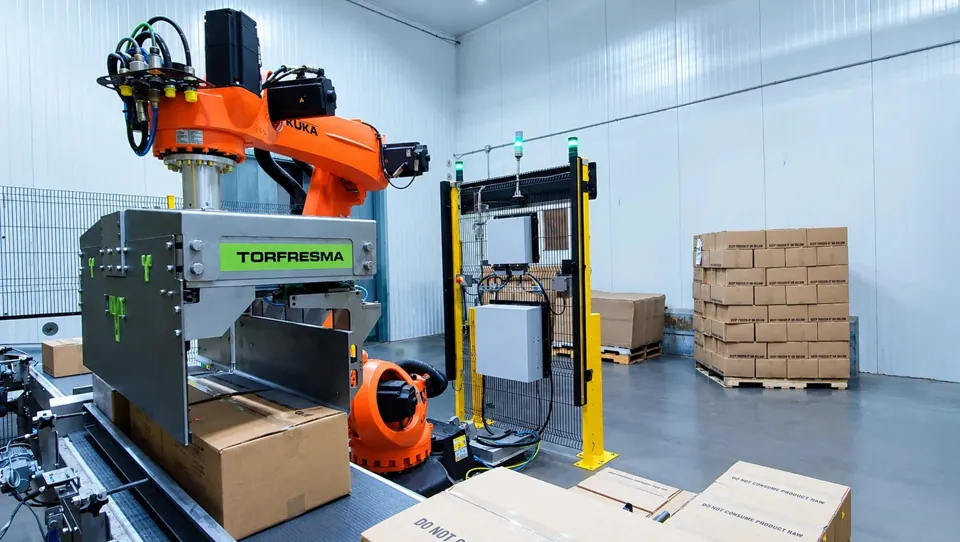
Can a bag palletizer connect to your bagger, conveyors and wrapper?
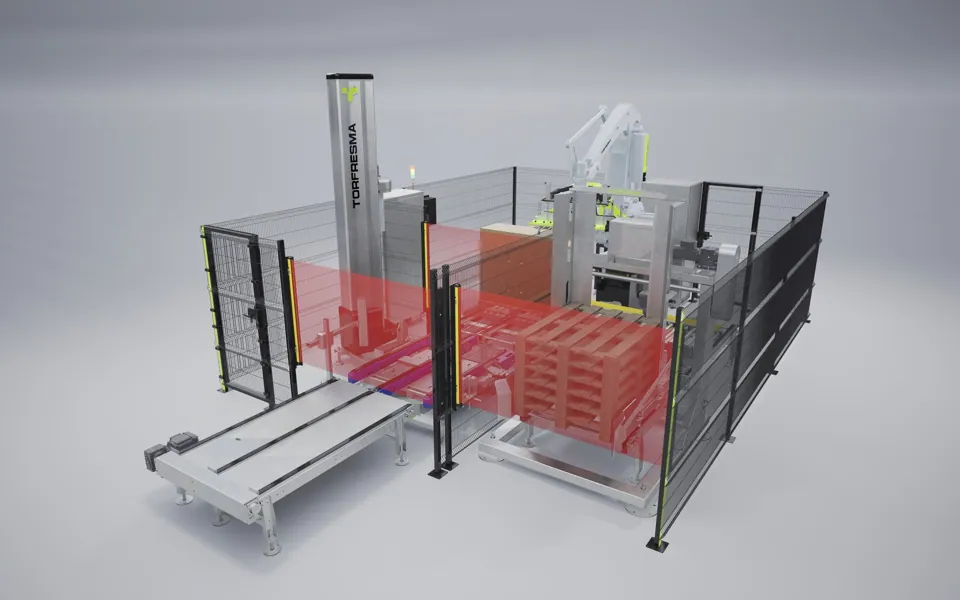
Yes, a bag palletizer connects to your bagger, conveyors and wrapper when TRF engineers the infeed, the palletizer and the pallet outfeed as one system instead of placing a robot at the end of a conveyor. The conveyor between the bagger and the robot absorbs rhythm differences and delivers bags spaced and oriented for the pick. TRFIntraflow provides the modules: conveying, curves and transfers, zero-pressure accumulation, metering, gapping, merges, diverts, inclines and elevators, with sensors, PLC, HMI and palletizer interfaces.
Accumulation matters on bag lines. A buffer ahead of the palletizer helps it finish a pallet exchange without stopping the bagger, and helps the bagger recover from a short stop without starving the robot. Downstream, the pallet moves to wrapping, labeling and the warehouse. When the whole end of the line is in scope, end-of-line integration puts case packing, conveying and palletizing under one partner accountable for the agreed project scope, from layout to startup.
Smaller retail bags, such as pet food or rice bags, are often packed into cases before palletizing. That flow uses a case packer such as TRFDroppack, covered on the bag case packer page, and a box palletizer, which also covers shipping cases, for the finished cases.
Can a bag palletizer also palletize bundles and multipacks?
Yes, the same bag palletizer platforms handle bundle palletizing, because TRF treats bags and bundles as one family of flexible loads without rigid walls. A bundle is a group of products held together as one unit without a closed case: a shrink-wrapped multipack of bottles or cans, a bundle on a pad or shallow tray inside the film, or a strapped stack of paper products, paperboard or blanks. Multipack palletizing and bag palletizing share the same questions, and both start with how the load behaves when it is lifted.
- Film-only shrink bundles have a soft bottom that flexes when lifted from the ends, so the end-of-arm tool supports the whole base. A shrink bundle palletizer also depends on the infeed: bundles leave the shrink tunnel with warm film, and a short conveyor section before the pick lets the film firm up.
- Pad or tray and shrink bundles give a firmer base, but film-on-film layers still slide, so interlocking patterns and tier sheets work the same way they do for bags.
- Strapped or banded bundles are rigid but heavy and sensitive to edge damage, so the tool spreads the pressure and keeps the straps intact.
A robotic bundle palletizer is selected by line setup and speed, like any other TRF palletizer. TRFSpeed can consolidate several bundling lines into one coordinated palletizing system, and a bundle heavier or larger than the published ranges is evaluated as a custom palletizer. TRF validates the bundle, the tool and the pattern with production bundles, and closed shipping cases go to the box palletizer instead.
How do you choose a bag palletizing system?
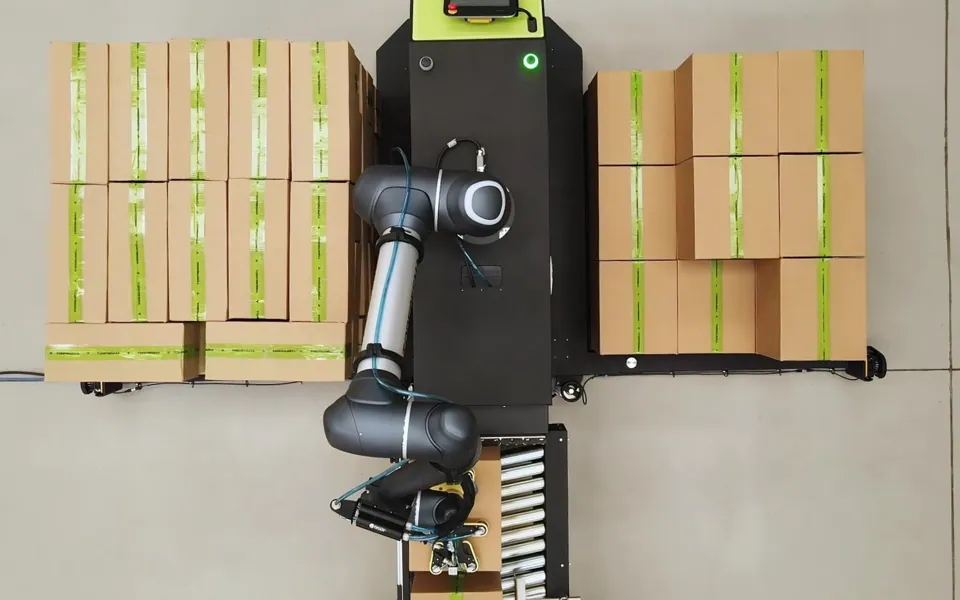
Choose by line setup and speed first: how many bags per minute the line produces, how many lines feed the palletizer and how much floor space the cell can use. Bag weight, end-of-arm tool and pallet pattern then confirm the choice.
| Platform | Typical speed | Case weight | Best fit |
|---|---|---|---|
| TRFCobot | Up to 10 cases per minute | Up to 26 lb | Lower-speed, high-mix lines with limited floor space and manual palletizing today |
| TRFCompact | Up to 15 cases per minute | Up to about 65 lb | Industrial duty cycle in a compact, standardized cell for brownfield plants and secondary lines |
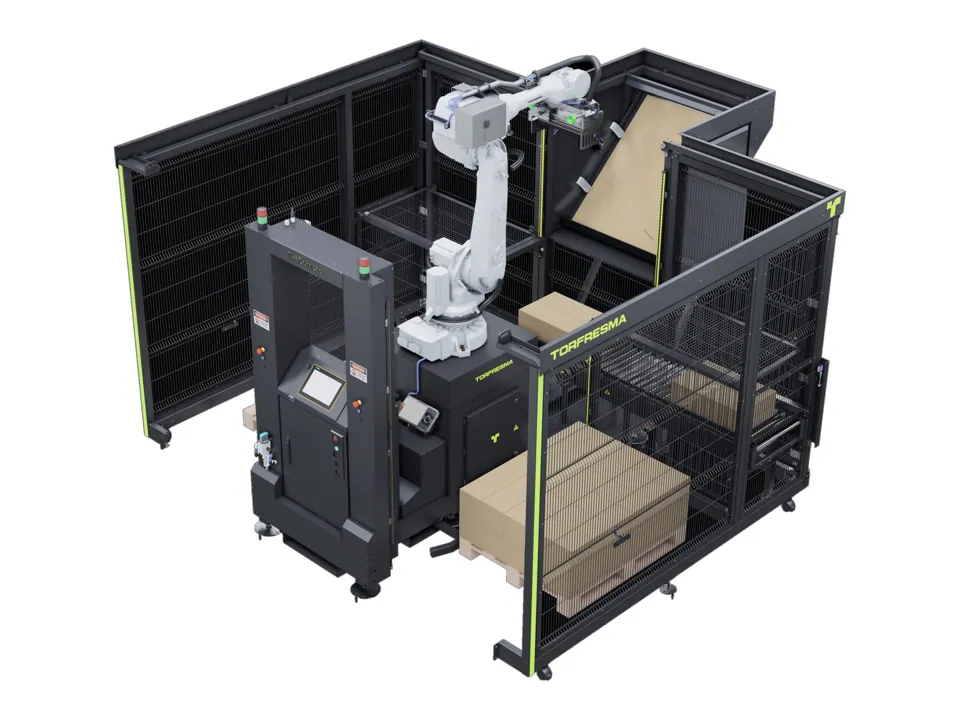
| TRFSpeed | 15 or more cases per minute | Up to about 80 lb | High-volume or continuous production, multi-line palletizing, multipick, automatic pallet handling and slip sheets |
| Custom palletizer | Defined by the project | Defined by the project | Products, loads, rates or layouts that the three platforms do not cover |
Published ranges are stated in cases for commercial screening. For bags, the rate, the bag weight and the platform are validated per application (product, end-of-arm tool, pallet pattern, reach and process).
When two platforms could both work, TRF recommends the one that matches your throughput, production intensity and growth plans, not simply the lowest initial investment. If your bags are palletized in a below-freezing area (below 32°F), TRFSubzero is the TRF palletizer built for that environment. Compare every model on the robotic palletizing page.
Questions
Frequently asked questions
Can the Same Palletizer Handle Shrink-Wrapped Bundles and Bags?
Yes, the same TRF palletizer can handle shrink-wrapped bundles and bags when the end-of-arm tool and the recipes are validated for each load. Bags and bundles are both flexible loads, so the platform stays the same while the tool and the pattern change with the product. Very different formats on one line, such as film bundles and strapped bundles, may need separate tools.
Can a Robotic Bag Palletizer Handle Different Bag Sizes and Pallet Patterns?
Yes, a robotic bag palletizer can handle different bag sizes and pallet patterns within the validated application. TRF palletizing platforms run multiple recipes, and each recipe holds the bag data and the pattern for one product, selected by the operator at changeover. Every bag size is validated with its end-of-arm tool and interlocked pattern during project engineering.
What Payload Does a Palletizing Robot Need for My Bags?
A palletizing robot for bags needs a payload that covers the filled bag plus the end-of-arm tool, and the combined weight of the bags in a multi-bag pick. Published case weights are up to 26 lb for TRFCobot, 65 lb for TRFCompact and 80 lb for TRFSpeed. TRF validates the payload with your filled bag, tool and pattern, and evaluates a custom palletizer above that range.
Can a Bag Palletizer Fit a Plant With Limited Floor Space?
A bag palletizer can often fit a plant with limited floor space. TRFCobot has a small footprint for areas where a traditional robotic cell is hard to install, and TRFCompact brings an industrial robot into a compact, standardized cell for brownfield plants. The area for the robot, the infeed pick point, the pallet positions and operator access to full pallets is confirmed with your layout and the robot reach.
How Much Does a Robotic Bag Palletizer Cost?
A robotic bag palletizer costs according to its platform, line speed, bag weight, end-of-arm tool, pallet handling and conveyor integration. As a reference, list prices are US$ 120,000 for the TRFCobot, US$ 180,000 for the TRFCompact Dual and US$ 350,000 for the TRFSpeed 100, EX Works Lenexa, Kansas, installation not included. The robotic palletizer cost page explains each cost factor.
Who Makes Robotic Bag Palletizers in the US?
TRF Industrial Automation makes robotic bag palletizers in the US, designing, building and installing them on TRFCobot, TRFCompact, TRFSpeed or as a custom palletizer. TRF also supplies the conveyors and end-of-line integration around the palletizer, and supports TRF equipment after startup through Parts and Service, with technical support and spare parts kept in the United States.
What Information Should I Prepare to Size a Bag Palletizer?
To size a bag palletizer, prepare your line rate in bags per minute, the heaviest and lightest bag weights, the bag construction, your pallet size and target height, the number of bagging lines and a drawing of the floor space. A TRF Sales Engineer uses this data to screen TRFCobot, TRFCompact, TRFSpeed or a custom palletizer and to validate the fit before quoting.
Start your bag palletizer evaluation
The right bag palletizer is sized to your line rate, your heaviest bag and the layout at the end of your line. Start with your line data: bag sizes and weights, rates, pallet patterns and a drawing of the area. A TRF Sales Engineer validates the fit, the end-of-arm tool and the reach.
Want to see TRF installations first? Browse the TRF case studies.
Next step
Keep your production running.
Tell us about your products, rates and floor space. A TRF Sales Engineer answers with the platform, the layout and the next step for your line.