
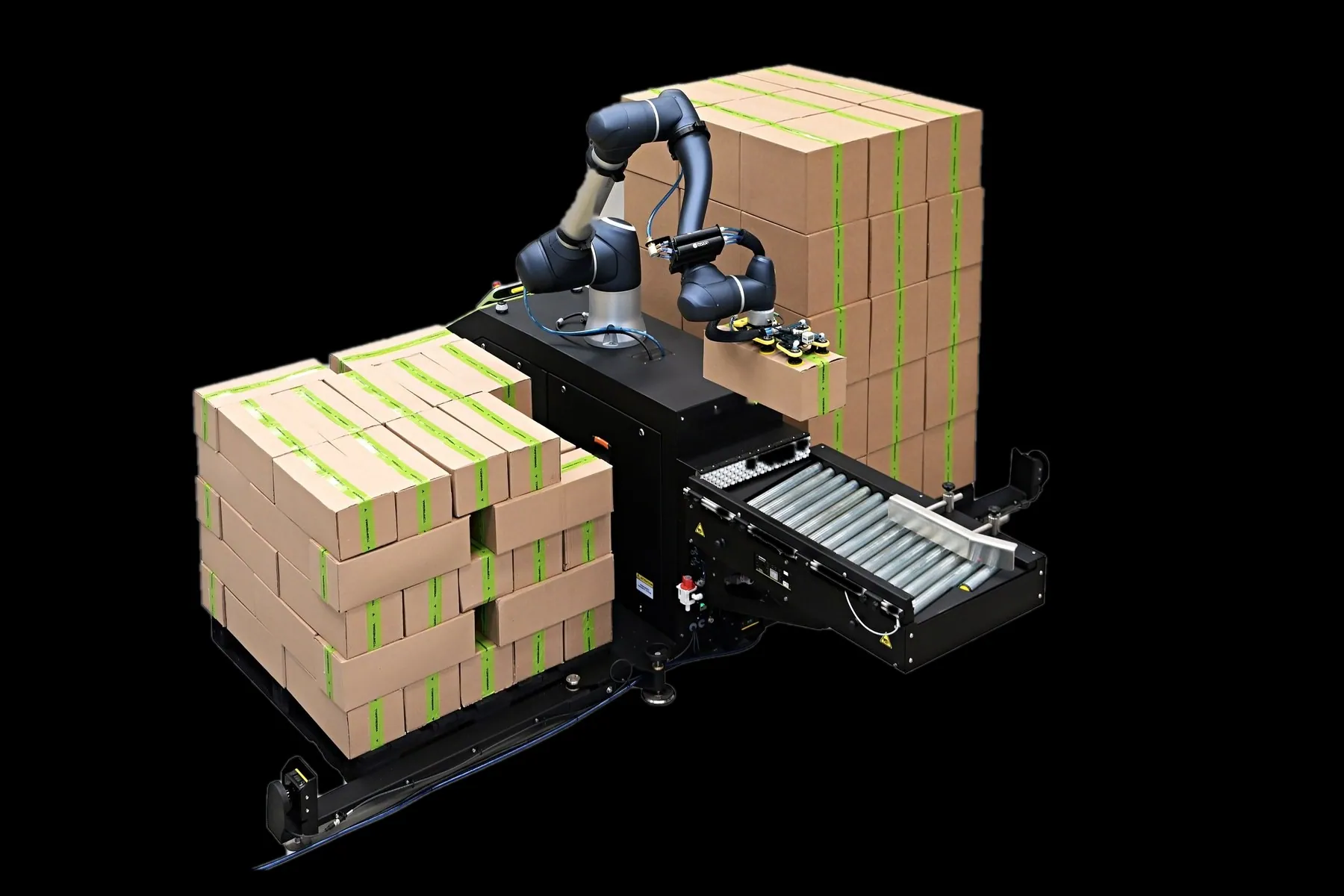
Robotic Palletizing / Pail and Bucket Palletizer
Pail palletizer and bucket palletizer sized to your line.
Pail palletizing evaluated per application, by filled weight, line rate and layout.
A pail palletizer, also called a bucket palletizer, is a robotic system that picks filled, lidded pails from the end of a filling line and stacks them onto pallets in a stable, repeatable pattern. TRF Industrial Automation evaluates pail applications on TRFCobot, TRFCompact and TRFSpeed within their published case weights, or as a custom palletizer, and the right model is defined by your line setup and speed.
Custom engineering
Solutions engineered for your production requirements.
Turnkey integration
From system design through installation and startup.
High reliability
Built for continuous operation.
U.S. support
Technical support for customers across the United States.
Lifecycle support
From startup to long-term performance.
Pail palletizer key facts
| Topic | What applies to pails and buckets |
|---|---|
| What it does | Picks closed pails from the infeed conveyor and stacks them on a pallet in a stored pattern |
| TRF models | TRFCobot, TRFCompact and TRFSpeed, plus a custom palletizer when the application falls outside them |
| What decides the model | Line setup and speed first, then filled pail weight, end-of-arm tool, reach and pallet pattern |
| Pail-specific engineering | Lid condition, bail handle position, label orientation and slip sheets between layers |
| What is validated | The actual pail, the end-of-arm tool, the pallet pattern, the robot reach and your process |
| Palletizing below 32°F | TRFSubzero, the TRF palletizer for below-freezing areas (below 32°F) |
What is a pail palletizer?
A pail palletizer is the last automated station of a pail filling line. It takes each closed pail from an infeed conveyor, sets it in a planned position on the pallet and repeats the cycle layer after layer until the load is complete. "Pail" and "bucket" describe the same container, so this page covers both.
Pails are demanding to palletize by hand. They are round or square, often filled with dense liquids, pastes or powders, and many carry a bail handle that swings freely. An operator lifts every pail from conveyor height, turns and sets it down near the floor for the first layer and at chest height for the top layer. A robotic pail palletizer takes that repetitive lifting, bending and twisting off your team.
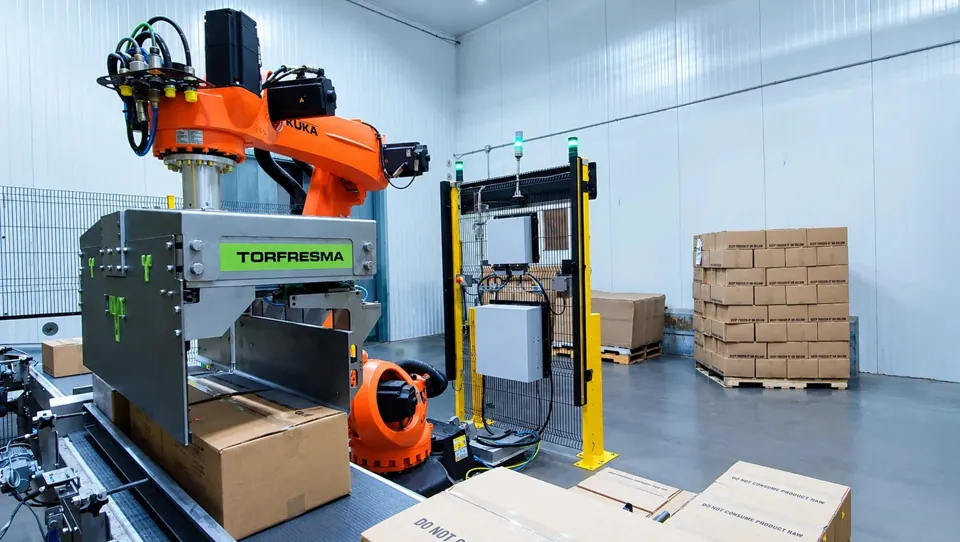
| Factor | Manual pail palletizing | Robotic pail palletizing |
|---|---|---|
| Lifting and ergonomics | Every pail is lifted, turned and placed by a person | The robot handles each pail |
| Pattern consistency | Depends on the operator, the shift and fatigue | The same stored recipe on every layer |
| Staffing | People dedicated to the pallet on every shift | Operators reassigned to supervision and quality checks |
| Size and pattern changes | The operator adapts the pattern from memory | A stored recipe for each pail size and pattern |
Pails are palletized in chemicals, household and cleaning products and food processing plants that ship ingredients in pails, and at co-packers that fill pails for several brands.
How does a robot grip pails with lids and bail handles?
The end-of-arm tool is selected for your pail, its lid and its handle, and validated with filled pails as they leave your line. A tool that holds the pail by its lid needs a flat, fully seated and dry lid. A tool that holds the pail body needs clearance around each pail, which the pallet pattern has to allow.
Bail handles are the detail most often underestimated. A handle that stands up can catch on the tool or on a neighboring pail, so the application review defines how the handle reaches the robot: folded flat, turned to a set position or held by the tool. Lids with tamper bands or spouts define where the tool can touch, and labels usually face outward on the finished pallet, so the recipe also controls the rotation of each pail.
At higher rates, a tool that picks more than one pail per cycle reduces the number of robot moves per pallet. Multipick is part of the TRFSpeed scope, and the combined weight of the pick is what engineering checks against the robot and the reach.
How are pails arranged on a pallet?
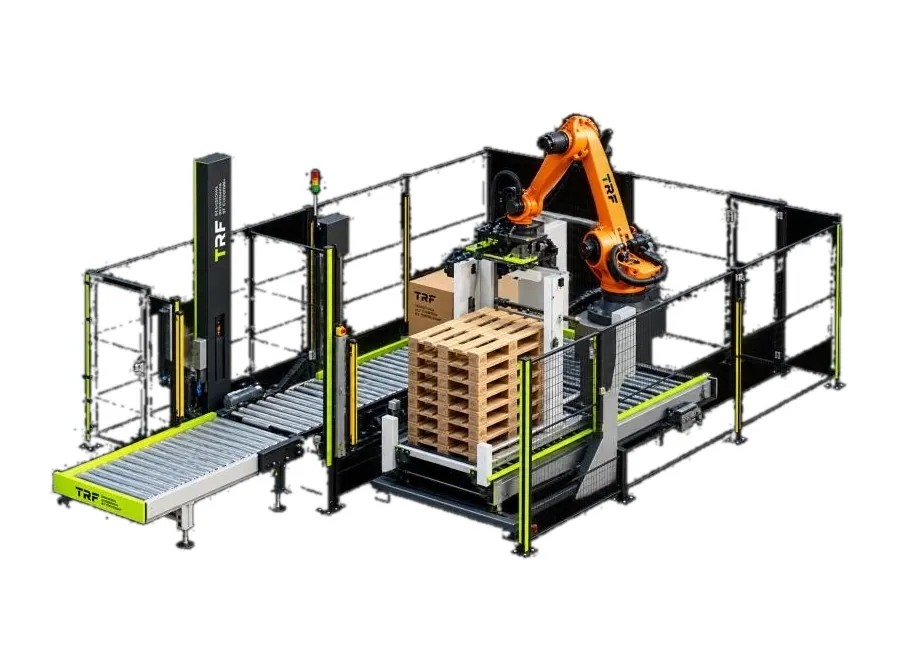
Pails go on the pallet in a square grid or an offset pattern, chosen for the pail shape and for how the load must rest. Round pails leave gaps between them however they are arranged. A square grid keeps each pail directly on top of the one below, which helps when pails are designed to stack lid to base. An offset pattern, where alternate rows shift by half a pail, can fit more pails per layer, but it changes how the load rests on the layer below. Square pails fill the pallet more completely and usually run in a block pattern.
Filled pails have small contact areas, so stability comes from three things working together: a pattern with no overhang at the pallet edge, a flat and consistent pallet, and, when needed, a slip sheet between layers that spreads the weight of the upper layer and keeps pails level. After palletizing, the load is stretch wrapped, and wrap settings are part of the stability plan. Every pattern is stored as a recipe, so it repeats identically on every pallet.
Can a pail palletizer be integrated with your filler, conveyors and wrapper?
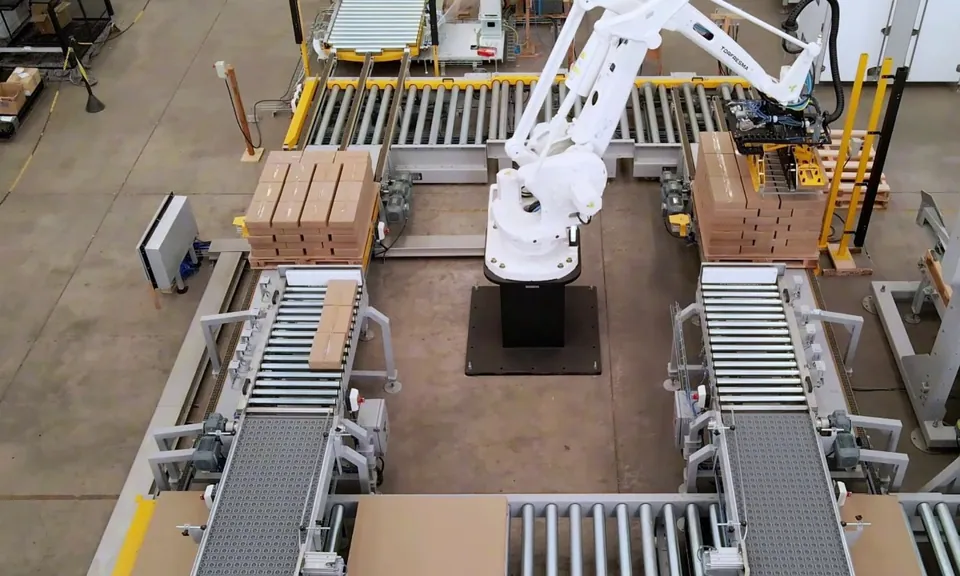
Yes. Upstream, a pail line usually runs a filler, a lid placer and press, weight verification and coding or labeling. The palletizer needs pails one at a time, correctly spaced, with the lid seated and the handle in a known position. Accumulation between the filler and the robot absorbs short stops, so a pallet exchange does not stop filling and a brief filler stop does not starve the robot.
TRF designs these connections as engineered systems, not as loose conveyor sections. TRFIntraflow provides modules for conveying, accumulation, diverting, routing, elevation and integration, and end-of-line integration brings the filling-line outfeed, palletizing, wrapping and labeling under one project with one partner accountable for the agreed project scope. TRFSpeed adds pallet handling, slip sheets and warehouse interfaces when the scope calls for them.
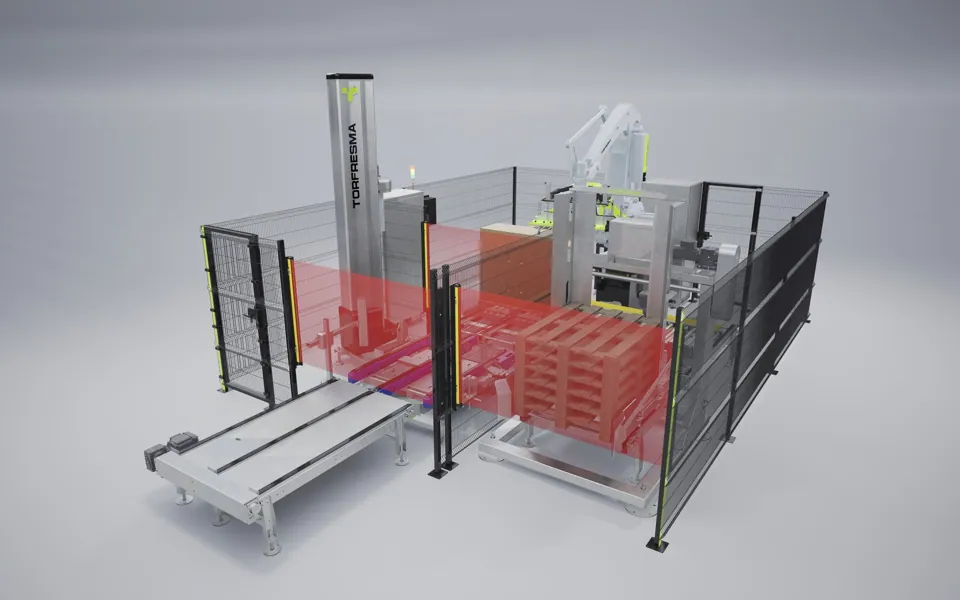
How do you choose a pail palletizer?
Choose by line setup and speed: how many pails per minute the filling line produces, how many lines feed the palletizer and how much floor space the cell can use. The filled pail weight, the end-of-arm tool and the pattern then confirm the choice.
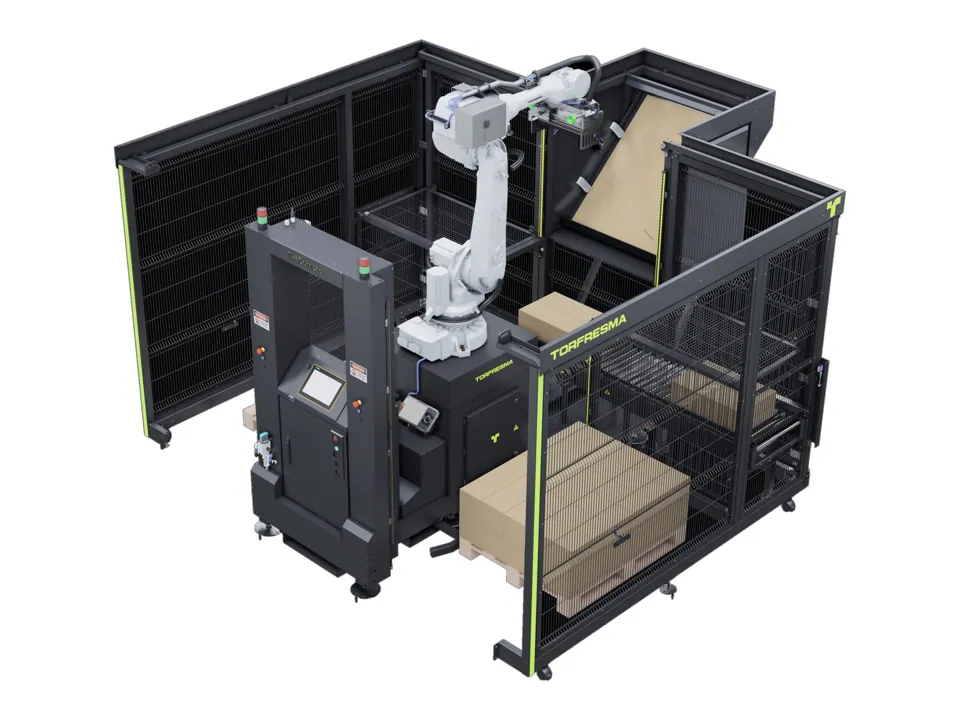
| Platform | Typical speed | Case weight | Best fit |
|---|---|---|---|
| TRFCobot | Up to 10 cases per minute | Up to 26 lb | Lower-speed, high-mix lines with limited floor space and manual palletizing today |
| TRFCompact | Up to 15 cases per minute | Up to about 65 lb | Industrial duty cycle in a compact, standardized cell for food, CPG and chemical plants with restricted space |
| TRFSpeed | 15 or more cases per minute | Up to about 80 lb | High-volume or continuous production, several filling lines into one area, multipick, pallet handling and slip sheets |
| Custom palletizer | Defined by the project | Defined by the project | Loads, containers, rates or layouts that the three platforms do not cover |
Published ranges are stated in cases for commercial screening. For pails, the rate, the filled weight and the platform are validated per application (product, end-of-arm tool, pallet pattern, reach and process).
When two platforms could both work, TRF recommends the one that matches your throughput, production intensity and growth plans, not simply the lowest initial investment, so the palletizer still fits when a second filling line arrives. Compare every model on the robotic palletizing page.
Questions
Frequently asked questions
Is a Bucket Palletizer the Same as a Pail Palletizer?
Yes, a bucket palletizer is the same as a pail palletizer: bucket and pail are two names for the same container, and the palletizing questions are identical, from filled weight and lid and handle design to line rate and pallet pattern. TRF treats both as one application and selects the platform, the end-of-arm tool and the pattern for your specific container.
How Many Pails per Minute Can a Robotic Palletizer Handle?
A robotic palletizer handles pails at the published case rates: up to 10 per minute on TRFCobot, up to 15 on TRFCompact and 15 or more on TRFSpeed, as typical ranges for commercial screening. At higher rates, a tool that picks more than one pail per cycle reduces robot moves. TRF confirms the final rate with your filled pail, tool, pattern and reach.
What Payload Does a Palletizing Robot Need for Filled Pails?
A palletizing robot for filled pails needs a payload that covers the filled pail plus the end-of-arm tool, and the combined weight of the pails in a multipick. Published case weights are up to 26 lb for TRFCobot, 65 lb for TRFCompact and 80 lb for TRFSpeed. A pail heavier than that range is evaluated as a custom palletizer project after the application review.
Can One Palletizer Handle Different Pail Sizes and Pallet Patterns?
Yes, one palletizer can handle different pail sizes and pallet patterns within the validated application. TRF palletizing platforms run multiple recipes, so the same pail palletizer can switch between sizes and patterns at changeover. Each size is validated with its end-of-arm tool and pattern during project engineering, and a wide size range may need an adjustable or interchangeable tool.
Can a Pail Palletizer Fit a Plant With Limited Floor Space?
A pail palletizer can often fit a plant with limited floor space. TRFCobot has a small footprint for areas where a traditional robotic cell is hard to install, and TRFCompact brings an industrial robot into a compact, standardized cell for brownfield plants that add a pail line where space is already committed. Layout, reach and operator access to full pallets are confirmed for each installation.
How Much Does a Pail Palletizer Cost?
A pail palletizer costs according to its platform, line speed, filled pail weight, end-of-arm tool, pallet handling and conveyor integration. As a reference, list prices are US$ 120,000 for the TRFCobot, US$ 180,000 for the TRFCompact Dual and US$ 350,000 for the TRFSpeed 100, EX Works Lenexa, Kansas, installation not included. The robotic palletizer cost page explains each factor.
What Information Should I Prepare to Size a Pail Palletizer?
To size a pail palletizer, prepare your pail sizes and filled weights, the lid and handle design, the line rate, your pallet size and target height, the number of filling lines and a drawing of the floor space. A TRF Sales Engineer uses this data to screen TRFCobot, TRFCompact, TRFSpeed or a custom palletizer, and the payback calculator gives you a first estimate.
Start your pail palletizer evaluation
A pail palletizer pays off when the platform matches your line, your heaviest pail and the space at the end of the filling line. Send TRF your pail sizes, filled weights, line rate and a drawing of the area, and a Sales Engineer will validate the end-of-arm tool, the pattern and the reach with your real pail.
Want to see TRF installations first? Browse the TRF case studies.
Next step
Keep your production running.
Tell us about your products, rates and floor space. A TRF Sales Engineer answers with the platform, the layout and the next step for your line.